Bordeaux France Facts: 88 Growths, a 114 m Spire and the Port of the Moon
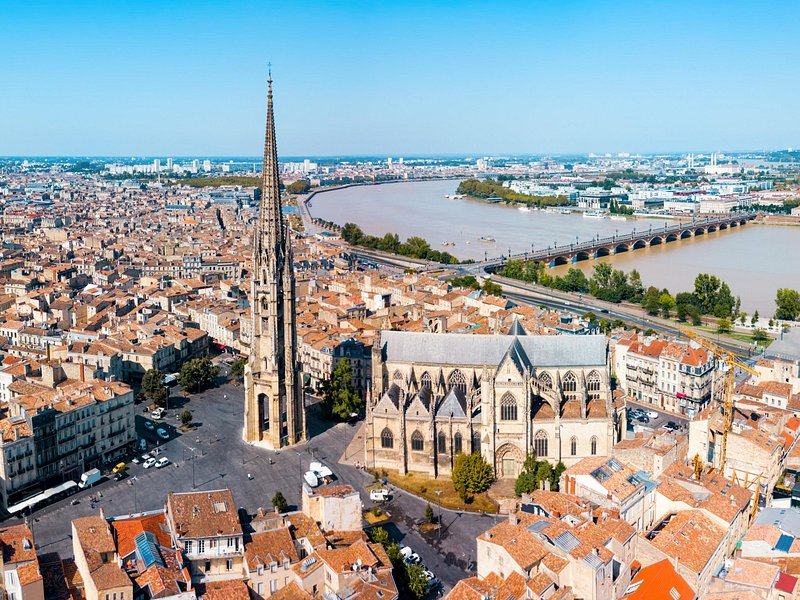
The short answer. Bordeaux's most famous wine list was drawn up by brokers in 1855 and has not changed since. Its UNESCO-listed city has more protected buildings than any in France outside Paris. And Saint-Émilion's church was dug out of the rock. Below are the facts that surprise visitors most, each from the body that keeps the record.
The figures at a glance
| Figure | What it counts | Who says so |
|---|---|---|
| 88 | Growths in the 1855 classification | The Bordeaux wine council |
| 85 | Châteaux in Saint-Émilion's 2022 classification | The Bordeaux wine council |
| 66% | Share of the red vineyard planted with Merlot | The Bordeaux wine council |
| 1,731 ha | The UNESCO-listed city, the Port of the Moon | UNESCO |
| 114 m | The Saint-Michel spire | The Bordeaux tourist office |
| 7,750 kg | The bell in the old city gate | The Bordeaux tourist office |
| 41.2 °C | The hottest day on record, 23 July 2019 | Météo-France |
1. The 1855 list was drawn up by brokers, not tasters
Napoleon III wanted Bordeaux's best wines ranked for the Paris Universal Exhibition of 1855. The city's wine brokers drew the list, from the prices the wines fetched. It named 88 growths: 60 Médoc reds, one red from the Graves and 27 sweet whites from Sauternes and Barsac. The wine council says the list never changes. So when you visit a Second Growth, you are looking at a price ranking from the 1850s.
2. One château is ranked twice
Château Haut-Brion is the only estate in both the 1855 list and the Graves list, which was drawn in 1953 and confirmed in 1959. It stands in Pessac-Léognan, and you can reach it on tram A from the city centre.
3. Saint-Émilion redraws its ranks every ten years
The right bank does the opposite of the Médoc. Saint-Émilion's first classification, in 1955, named 75 châteaux. The seventh, in 2022, named 85. A panel from outside the Bordeaux trade tastes the wines, and the château's reputation, its land and its welcome to visitors also count. A château you visit this year can move up, or down, at the next edition.
4. Pomerol has never ranked its wines
Next door, Pomerol has no classification at all. It covers 813 hectares, about 0.7% of the region, and the wine council says each estate's name and price set the order. Merlot covers 80% of its vines.
5. Bordeaux wine did not begin in Saint-Émilion
One tour listing calls Saint-Émilion "the birthplace of the Bordeaux wines". The wine council does not agree. It gives that title to the Graves, south of the city, and calls them the birthplace of the city's winemaking heritage. UNESCO says only that the Romans brought vines to the Saint-Émilion area. So if a guide tells you wine began in the village, ask about the Graves.
6. The underground church was cut from the rock
In Saint-Émilion, the Monolithic Church was dug out in the early 12th century. It is 38 m long and 12 m high, and its bell tower rises 68 m, the highest point of the village. The wine council tells of Émilion, a hermit who died around 767 after seventeen years in a cave beside the church. You cannot walk in on your own: the tourist office runs guided visits only.
7. The wine brotherhood is over 800 years old
Saint-Émilion's Jurade, its wine brotherhood, has existed for more than 800 years and has 140 members, according to the wine council.
8. The city was listed for the Enlightenment
UNESCO inscribed Bordeaux, the Port of the Moon, in 2007. The listed city covers 1,731 hectares, and UNESCO counts more protected buildings here than in any French city except Paris. The long stone façades on the quays are the 18th-century city you are walking through.
9. The water mirror is two centimetres deep
Place de la Bourse was built from 1720 to open the walled city to its river. Opposite it, the water mirror lays 2 cm of water over a granite slab, fed from an 800 m³ tank below. It runs every day from 10:00 to 22:00 outside the winter period, and it costs you nothing.
10. The Saint-Michel spire is the fourth-highest in France
The spire of Saint-Michel stands 114 m high, finished in 1492. It reopened in June after restoration from 2022 to 2025. You climb 230 steps to the top, from April to October, for EUR 7, and children under 13 go free.
11. The old gate's bell weighs 7,750 kg
The Grosse Cloche was also a prison, and you can visit its cells with a guide. Its bell, cast in 1775, rings at 11:00 on six days a year: 1 January, 1 May, 8 May, 14 July, 28 August and 11 November. Since July 2016 it also rings at noon on the first Sunday of each month.
12. The cathedral's bell tower stands on its own
Eleanor of Aquitaine married the future Louis VII in the cathedral of Saint-André in 1137. Its bell tower, the Pey-Berland tower, was begun in 1440 and stands apart from the church. You climb 233 steps to its 50 m top, under an 11-tonne bell hung in 1853.
13. Bordeaux has touched 41 °C
Météo-France's station at Mérignac recorded 41.2 °C on 23 July 2019, and −16.4 °C on 16 January 1985. The normal year brings about 2,070 hours of sunshine and 925 mm of rain. In July and August, about eight days a month pass 30 °C, so plan a vineyard day in the morning. The months are laid out on Bordeaux weather by month.
How to see these for yourself
- In the city: the water mirror, the spire and the old gate all sit on a walk of the old town; the things to do page has each one's hours.
- In Saint-Émilion: book the underground visit at the tourist office, or take the one small-group day that includes it.
- In the Médoc: drive past the ranked names with a guide, and taste at two or three of them.
The city facts come alive on foot: every guided walk is on Bordeaux walking tours. For the classified châteaux, see Bordeaux wine tours.
Walks and days that tell these stories on the spot
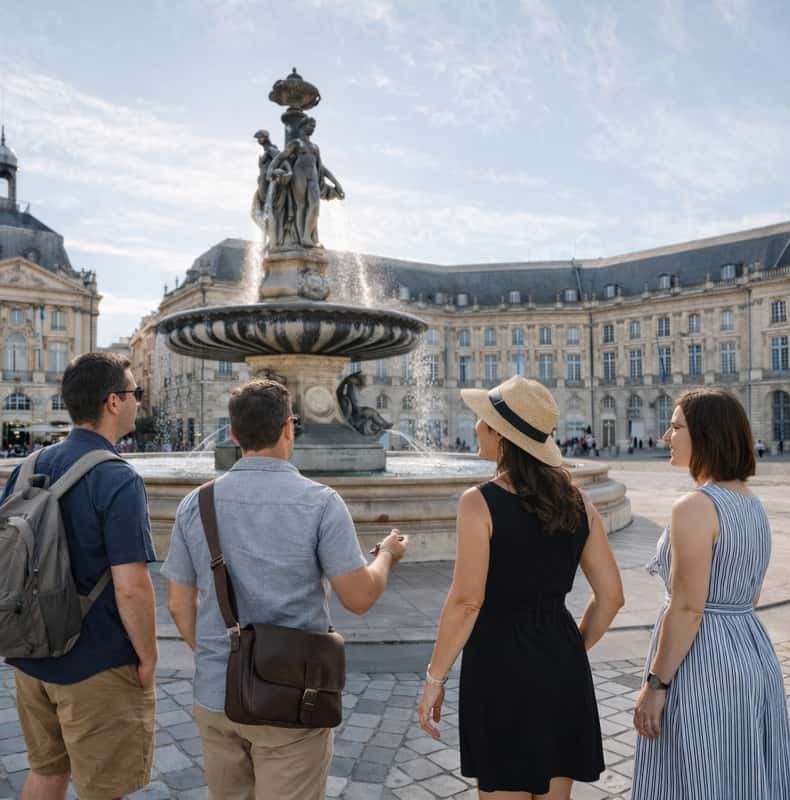
Bordeaux Historical Walking Tour + 1 Glass of Wine
Two hours on foot through the old city from the cathedral with an English-speaking guide, and a coupon for a glass of wine at a partner bar, which closes on Sundays.
From $16 per person
Check Availability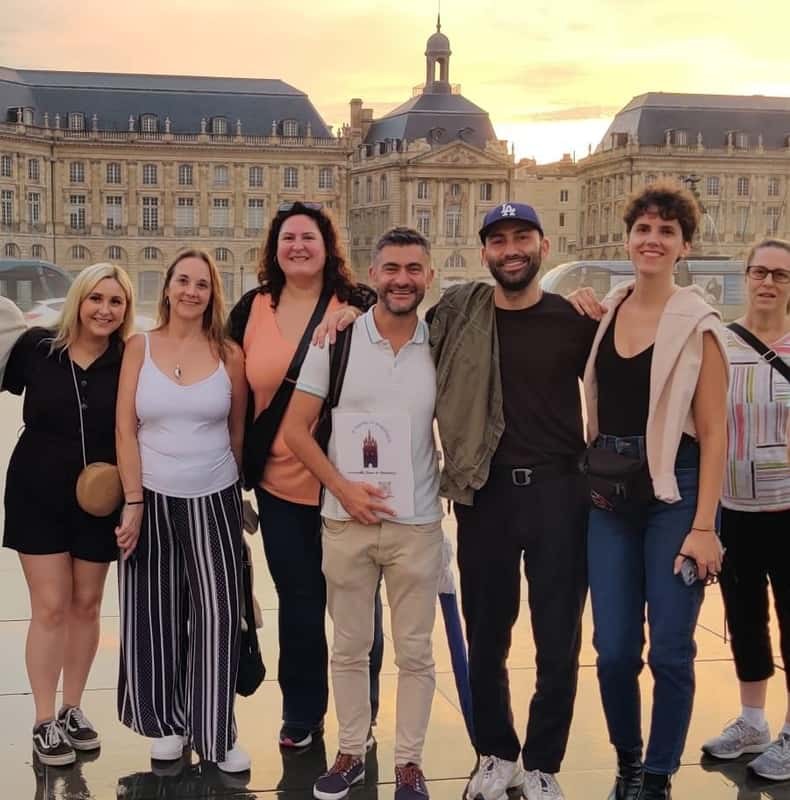
Bordeaux by Night: Small-Group Walking Tour
Two hours on foot after dark from the fountain on Place de la Bourse, in a small group, with one canelé in the fare. Wear shoes for a brisk pace.
From $31 per person
Check Availability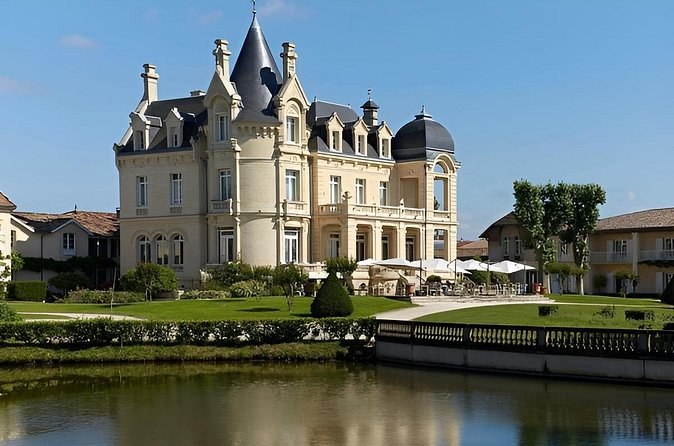
Private Tour in Saint-Émilion: Wineries GRAND CRU CLASSE
A private day among Saint-Émilion's Grands Crus Classés with a WSET-certified guide, hotel pickup, and the visits and tastings in the fare. Children can come on a child ticket; lunch is extra.
From $573 per person
Check AvailabilityNext: See which of these you can visit in a day on things to do in Bordeaux. Every fare sits side by side on Bordeaux France Tours.